CorpusMind Lens
كوربَس مايند لِنز
A standalone desktop application for vision-language-model-powered image understanding and multimodal discourse analysis
CorpusMind Lens is a standalone companion application to CorpusMind, designed specifically for researchers working at the intersection of visual and linguistic discourse. It ships its own bundled analysis engine and provides a focused workspace for image-set management, social media corpus building, vision-language-model image description, and multimodal discourse analysis across twelve theoretical frameworks. The application operates entirely on local hardware using Ollama or LM Studio; no image data, model queries, or analytical output is transmitted to any external server. All interpretive claims are phrased as hypotheses grounded in specific visual or textual evidence, following the methodological commitment to transparency and reproducibility that underpins the CorpusMind platform.
Analytical Capabilities
القدرات التحليلية
Image-Set Management
إدارة مجموعات الصور
Researchers organise images into sets within a corpus, upload via drag-and-drop with optional captions, and receive automatic cached analysis including Tesseract OCR text extraction, dominant colour palette computation, and composition geometry (rule-of-thirds, salience centre, visual balance).
يُنظّم الباحثون الصور في مجموعات ضمن المدونة، ويُرفعونها بالسحب والإفلات مع تعليقات اختيارية، ويتلقّون تحليلًا تلقائيًا مخزّنًا يشمل استخراج النصوص عبر Tesseract، وحساب لوحة الألوان السائدة، وهندسة التكوين (قاعدة الأثلاث، مركز البروز، التوازن البصري).
Vision-Language-Model Description
الوصف عبر نموذج الرؤية اللغوية
Image bytes are transmitted directly to a local vision-language model (e.g., Qwen2.5-VL, Llama 3.2 Vision) which produces a grounded description. The system records full provenance metadata (model name, provider, prompt hash, timestamp) for reproducibility. When the model's text reading diverges from the cached Tesseract OCR, both are presented side by side rather than silently overwriting either.
تُرسل وحدات بايت الصورة مباشرةً إلى نموذج رؤية لغوية محلي (مثل Qwen2.5-VL أو llama3.2-vision) الذي يُنتج وصفًا مُستندًا إلى الأدلة. يُسجّل النظام بيانات المصدر الكاملة (اسم النموذج، المُزوّد، تجزئة الاستفسار، الطابع الزمني) لضمان إعادة الإنتاج. عندما تختلف قراءة النموذج عن نص Tesseract المخزّن، يُعرض كلاهما جنبًا إلى جنب بدلاً من الكتابة فوق أحدهما بصمت.
Twelve Discourse-Theoretical Frameworks
اثنا عشر إطارًا نظريًا لتحليل الخطاب
Each framework operates in two modes: a fast heuristic path (colour, composition, OCR, caption) and a vision-LM path (?mode=llm) that sends the image and the framework's theoretical lens to the model. The twelve versioned, editable lenses: Social Semiotics (Kress & van Leeuwen), Barthes, Peirce, Systemic Functional Linguistics (Halliday), Appraisal (Martin & White), CDA (Fairclough), Socio-Cognitive (van Dijk), Discourse-Historical (Wodak), Multimodal CDA (Machin & Mayr), Classical Rhetoric (Aristotle), Argumentation (Toulmin), and Conceptual Metaphor Theory (Lakoff & Johnson).
يعمل كل إطار في وضعين: مسار استدلالي سريع (اللون، التكوين، استخراج النص، التعليق) ومسار نموذج الرؤية (?mode=llm) الذي يُرسل الصورة وعدسة الإطار النظري إلى النموذج. الأطر الاثنا عشر المُصدَّرة والقابلة للتحرير: السميوطيقا الاجتماعية (كريس وفان ليوين)، وبارت، وبيرس، واللسانيات الوظيفية النظامية (هاليداي)، ونظرية التقويم (مارتن ووايت)، والتحليل النقدي للخطاب (فيركلوف)، والمقاربة الاجتماعية المعرفية (فان دايك)، والمقاربة التاريخية الخطابية (فوداك)، والتحليل النقدي متعدد الأنماط (ماشين وماير)، والبلاغة الكلاسيكية (أرسطو)، والحجاج (تولمين)، ونظرية الاستعارة التصورية (لاكوف وجونسون).
Image-Text Alignment Inspector
مُفتّش محاذاة الصورة والنص
Aligns image regions with text spans using three modes: heuristic (colour-term and positional matching), vision-LM (the model identifies which text fragments refer to which image regions), or both displayed side by side. The user can compare which mode produced which alignment, maintaining analytical transparency.
يُحاذي مناطق الصورة مع مقاطع النص باستخدام ثلاثة أوضاع: استدلالي (مطابقة المصطلحات اللونية والموضعية)، ونموذج الرؤية (يُحدد النموذج أي المقاطع النصية تشير إلى أي مناطق في الصورة)، أو كلاهما معروضًا جنبًا إلى جنب. يمكن للمستخدم مُقارنة أي وضع أنتج أي محاذاة، مما يُحافظ على الشفافية التحليلية.
Cross-Image Batch Analysis
التحليل الدفعي عبر الصور
Aggregates cached vision-LM analysis across all images in a set: surfaces recurring framework themes (grouped by theoretical lens, counted by category), produces an OCR-derived word-frequency list, and summarises all vision-LM descriptions. Enables pattern identification across a corpus of images without manual inspection of each.
يُجمّع التحليل المخزّن بنموذج الرؤية عبر جميع الصور في المجموعة: يُبرز السمات المتكررة للأطر (مُجمّعة حسب العدسة النظرية، مَعدودة حسب الفئة)، ويُنتج قائمة تردد كلمات مستمدة من استخراج النصوص، ويُلخّص جميع أوصاف نموذج الرؤية. يُتيح تحديد الأنماط عبر مدونة من الصور دون فحص يدوي لكل صورة.
Ethical Consent Gate
بوابة الموافقة الأخلاقية
All person-descriptive content generated by vision-language models, including age, gender, facial expression, physical appearance, ethnicity, religious attire, and socioeconomic indicators, is automatically redacted from responses unless the researcher explicitly enables facial analysis in Settings. The redaction operates at the sentence level and applies across all vision-LM routes, including cached results.
يُحجب تلقائيًا جميع المحتوى الوصفي للأشخاص المُولّد بواسطة نماذج الرؤية اللغوية، بما في ذلك العمر، والجنس، وتعابير الوجه، والمظهر الجسدي، والعرق، والملابس الدينية، والمؤشرات الاجتماعية والاقتصادية، من الردود ما لم يُفعّل الباحث تحليل الوجه صراحةً في الإعدادات. يعمل الحجب على مستوى الجملة ويُطبّق عبر جميع مسارات نموذج الرؤية، بما في ذلك النتائج المخزّنة.
Social Media Corpora
مدونات وسائل التواصل الاجتماعي
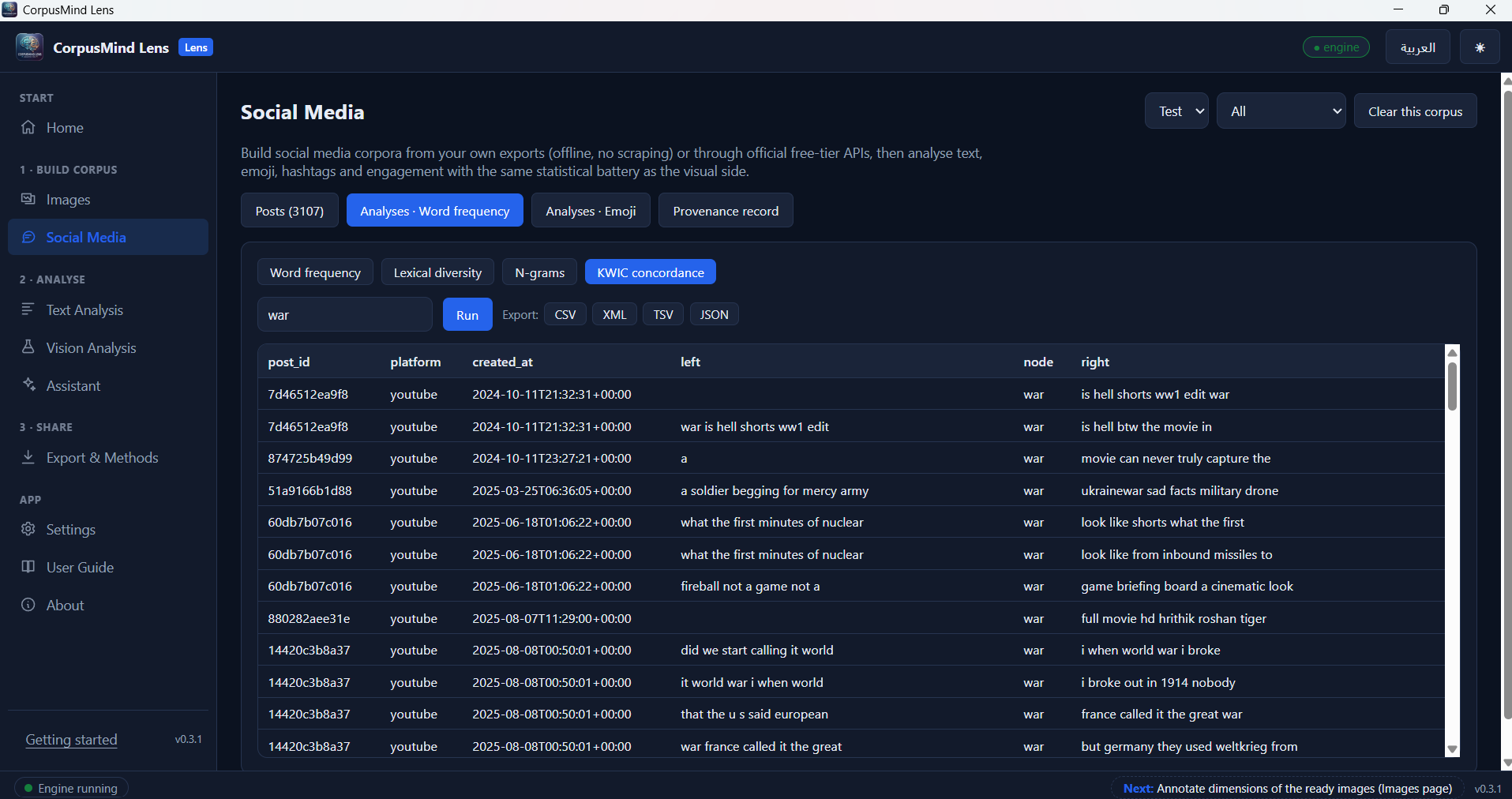
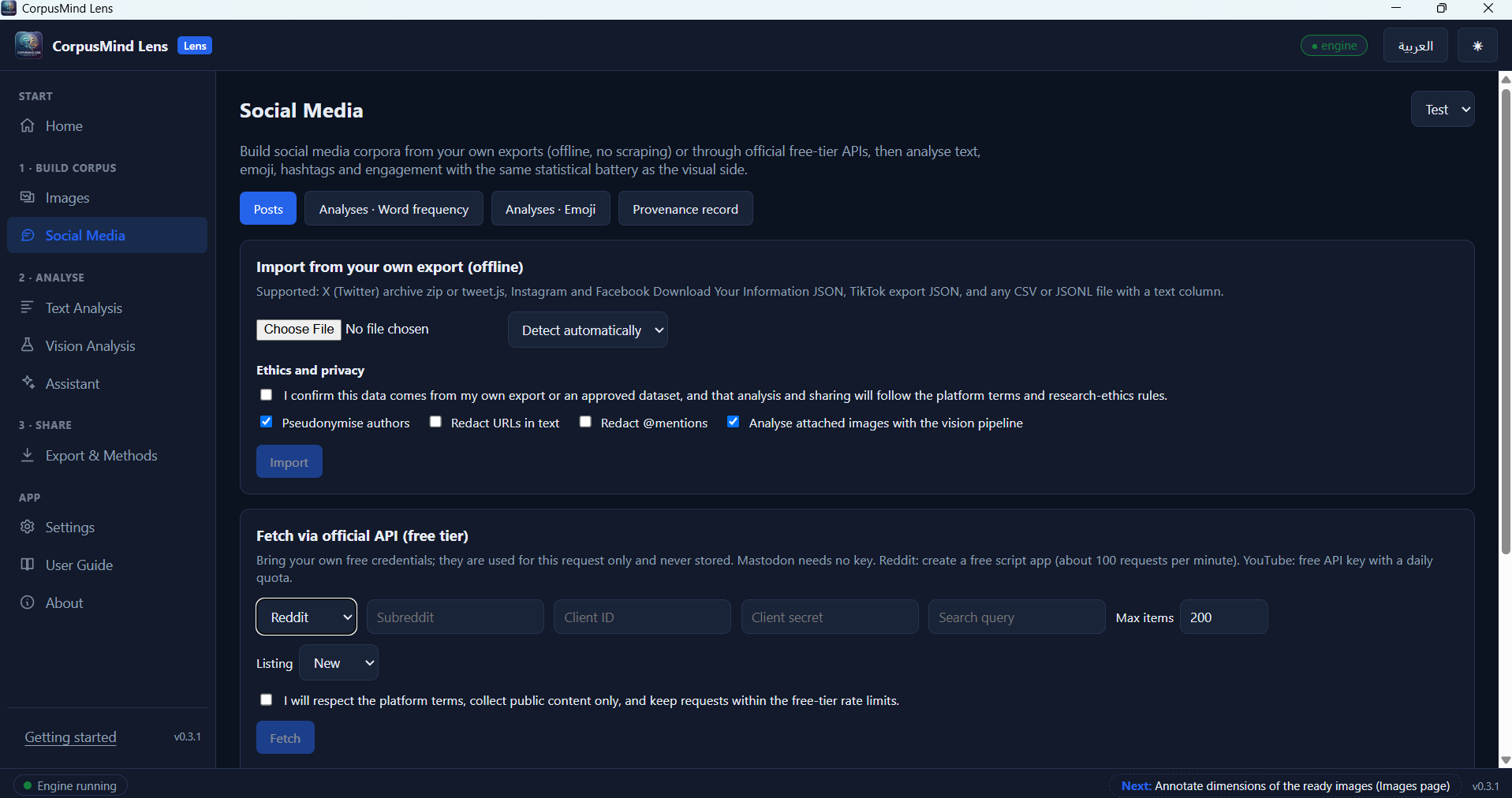
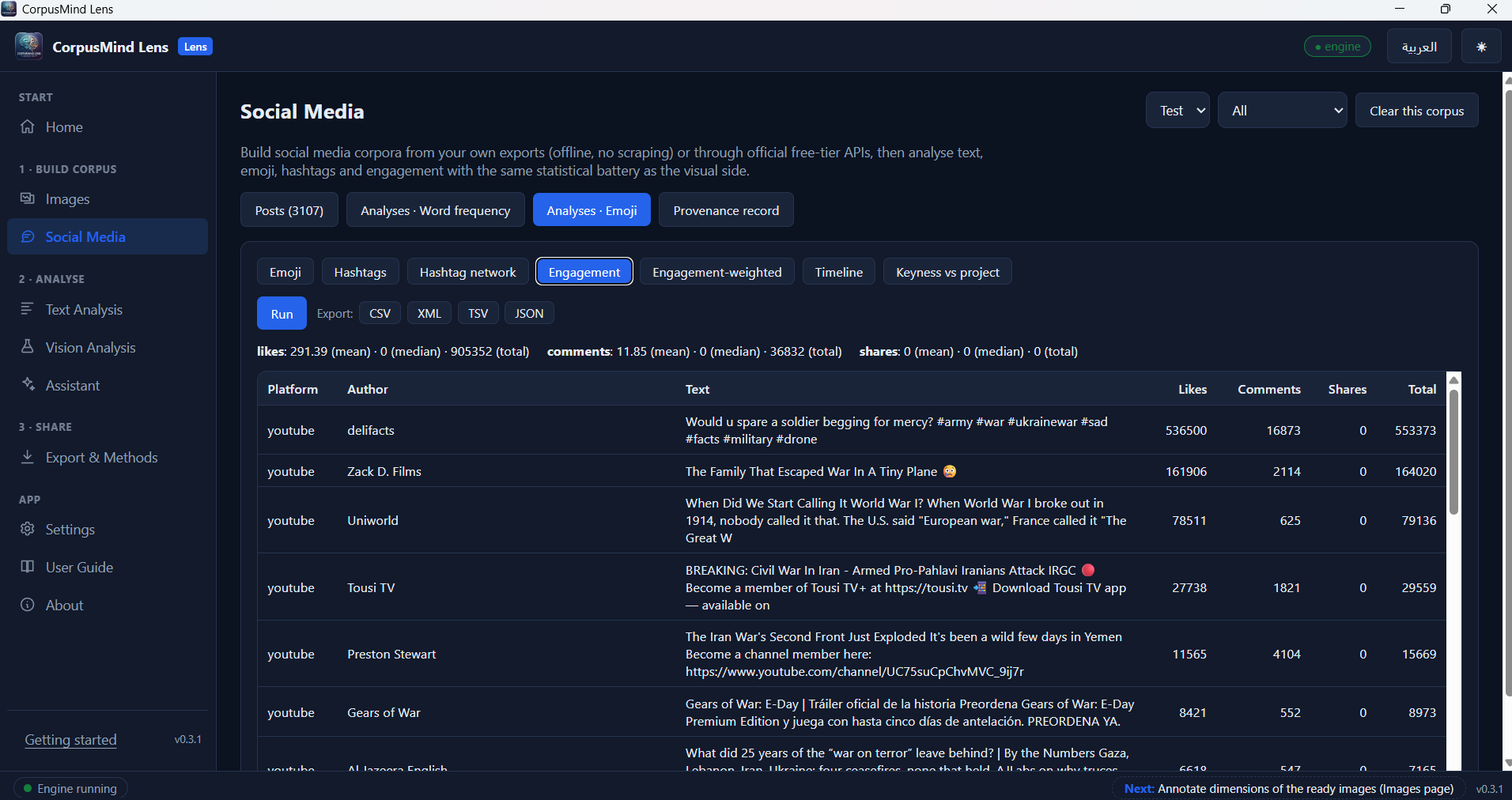
Build social media corpora in two ethical ways: offline imports of your own archives and exports (X/Twitter archive, Instagram and Facebook Download Your Information, TikTok exports, generic CSV or JSONL) with no scraping and no network access, or official free-tier APIs connected with your own credentials (Mastodon, Reddit, YouTube). Posts enter the same statistical battery as images: word and emoji frequency, hashtags, n-grams, concordance, engagement metrics, co-occurrence networks, and cross-corpus keyness. Authors are pseudonymised, optional redaction runs before storage, and every import records a signed provenance attestation.
أنشئ مدونات لوسائل التواصل الاجتماعي بطريقتين أخلاقيتين: استيراد دون اتصال لأرشيفك وتصديراتك (أرشيف X/تويتر، تنزيل معلوماتك من إنستغرام وفيسبوك، تصديرات تيك توك، ملفات CSV أو JSONL عامة) دون كشط ولا اتصال بالشبكة، أو واجهات برمجية رسمية مجانية تربطها ببيانات اعتمادك الخاصة (ماستودون وريديت ويوتيوب). تدخل المنشورات نفس البطارية الإحصائية المتاحة للصور: تردد الكلمات والإيموجي، والوسوم، والـn-grams، والكونكوردانس، ومقاييس التفاعل، وشبكات التجاور، والمفتاحية بين المدونات. تُستبدل هويات المؤلفين بأسماء مستعارة، ويُطبَّق الحجب الاختياري قبل التخزين، ويُسجَّل إثبات مصدر موقّع لكل عملية استيراد.
Local Model Management
إدارة النماذج المحلية
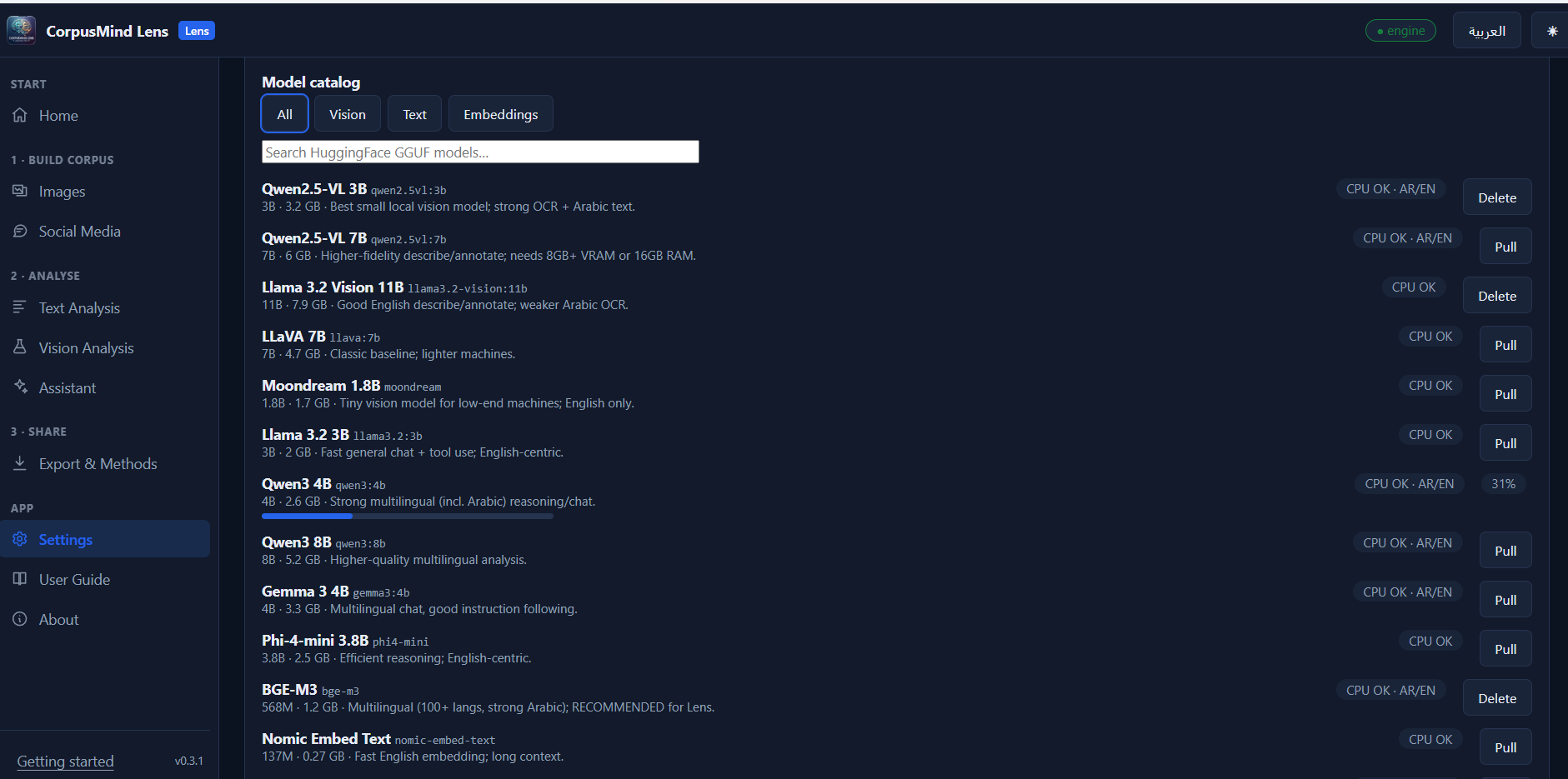
The Settings view lists a curated catalogue of 13 local models across three tasks (vision description, text analysis, multilingual embeddings) with download sizes and RAM/VRAM requirements, plus an honest fit badge computed from your machine's actual specs. If Ollama is missing, one click installs it silently; the catalogue can pull any model with live progress, search Hugging Face GGUF repositories, and remove models you no longer need.
تعرض شاشة الإعدادات كتالوجًا منسّقًا من 13 نموذجًا محليًا عبر ثلاث مهام (وصف الصور، تحليل النصوص، التضمينات متعددة اللغات) مع أحجام التنزيل ومتطلبات الذاكرة، ومع شارة ملاءمة صادقة تُحسب من مواصفات جهزك الفعلية. إذا لم يكن Ollama مثبَّتًا، فإن نقرة واحدة تثبته بصمت؛ ويمكن للكتالوج تنزيل أي نموذج مع عرض التقدم، والبحث في مستودعات Hugging Face GGUF، وحذف النماذج التي لم تعد تحتاجها.
Full Text Analysis Layer
طبقة تحليل نصي كاملة
New in 0.3.0: the classic corpus-linguistics toolset runs over the OCR text and captions of every image set. Word lists with editable stoplists, a concordancer with regular expressions and sort positions, collocations ranked by MI, t-score, log-likelihood, LogDice or delta P with an interactive network view, n-grams and lexical bundles, dispersion measures, and keyness against bundled English and Arabic reference frequency lists (BE06, Leipzig, CAMEL), with significance and effect size always reported together. A word sketch adds each word's typical visual co-patterns: colours, annotations and detected objects.
جديد في 0.3.0: عدّة اللغويات الكوربسية الكلاسيكية تعمل على نص OCR والتعليقات لكل مجموعة صور. قوائم كلمات بقوائم وظيفية قابلة للتحرير، وحواشٍ سياقية بتعبيرات نمطية ومراتب ترتيب، وألفتات تُرتَّب بـ MI أو t أو لوغاريتم الأرجحية أو LogDice أو دلتا P مع عرض شبكي تفاعلي، ومتتابعات وحزم معجمية، ومقاييس انتشار، ولفتانية مقابل قوائم مرجعية مدمجة للإنجليزية والعربية (BE06 وLeipzig وCAMEL)، مع عرض الدلالة وحجم الأثر معًا دائمًا. ويضيف «البروفيل المعجمي» الأنساق البصرية الاعتادية لكل كلمة: الألوان والتعليقات والأشياء المكتشفة.
Workflow Menu and Task Bar
قائمة سير العمل وشريط المهام
New in 0.3.0: a full functional menu organised the way research actually flows (build corpus, analyse, share), one tool per page with nothing hidden, and a permanent task bar that shows engine status, background processing counts, and a suggested next step. When something fails, a red issue badge opens plain-language explanations with instant offline fixes and, when a local AI model is installed, a deeper interpretation generated entirely on your machine; nothing is ever sent to the cloud.
جديد في 0.3.0: قائمة كاملة بالوظائف مرتّبة كما يسير البحث فعلًا (ابنِ الكوربس، حلِّل، شارك)، أداة في كل صفحة بلا أي إخفاء، وشريط مهام دائم يعرض حالة المحرك وعدّاد المعالجة في الخلفية والخطوة التالية المقترحة. وعند فشل شيء تفتح شارة حمراء شرحًا بلغة بسيطة مع حلول فورية دون اتصال، وإن كان هناك نموذج ذكاء محلي مثبَّت فإن تفسيرًا أعمق يُولَّد كاملًا على جهازك؛ ولا يُرسَل شيء إلى السحابة أبدًا.
Publication-Ready Exports
تصدير جاهز للنشر
Every result exports for archival and publication: CSV, TSV, XML, JSON, and Excel (XLSX) across statistical measures, discourse batteries, social analyses, and posts. A Methods Section draft documents the analytical pipeline in citation-ready prose, and discourse claims export with their evidence identifiers and confidence values so that every interpretation can be audited.
تُصدَّر جميع النتائج للأرشفة والنشر بصيغ CSV وTSV وXML وJSON وExcel (XLSX) عبر المقاييس الإحصائية وبطاريات تحليل الخطاب وتحليلات وسائل التواصل والمنشورات. تُوثّق مسودة قسم المنهجيات مسار التحليل بنثر جاهز للاقتباس، وتُصدَّر ادعاءات الخطاب مع مُعرّفات الأدلة وقيم الثقة حتى قابل كل تفسير للتدقيق.
CorpusMind Lens in Action
كوربَس مايند لِنز أثناء العمل
A guided visual tour of the main workspaces — from the welcome screen, image-set management and annotation dimensions to social-media corpora, engagement analytics and the local model catalogue. Use the arrows, the dots, or your keyboard; click any screenshot to view it full size. جولة بصرية موجَّهة عبر مساحات العمل الرئيسية — من شاشة الترحيب وإدارة مجموعات الصور وأبعاد الوسم إلى مدونات وسائل التواصل وتحليلات التفاعل وكتالوج النماذج المحلية. استخدم الأسهم أو النقاط أو لوحة المفاتيح؛ وانقر على أي لقطة لعرضها بالحجم الكامل.
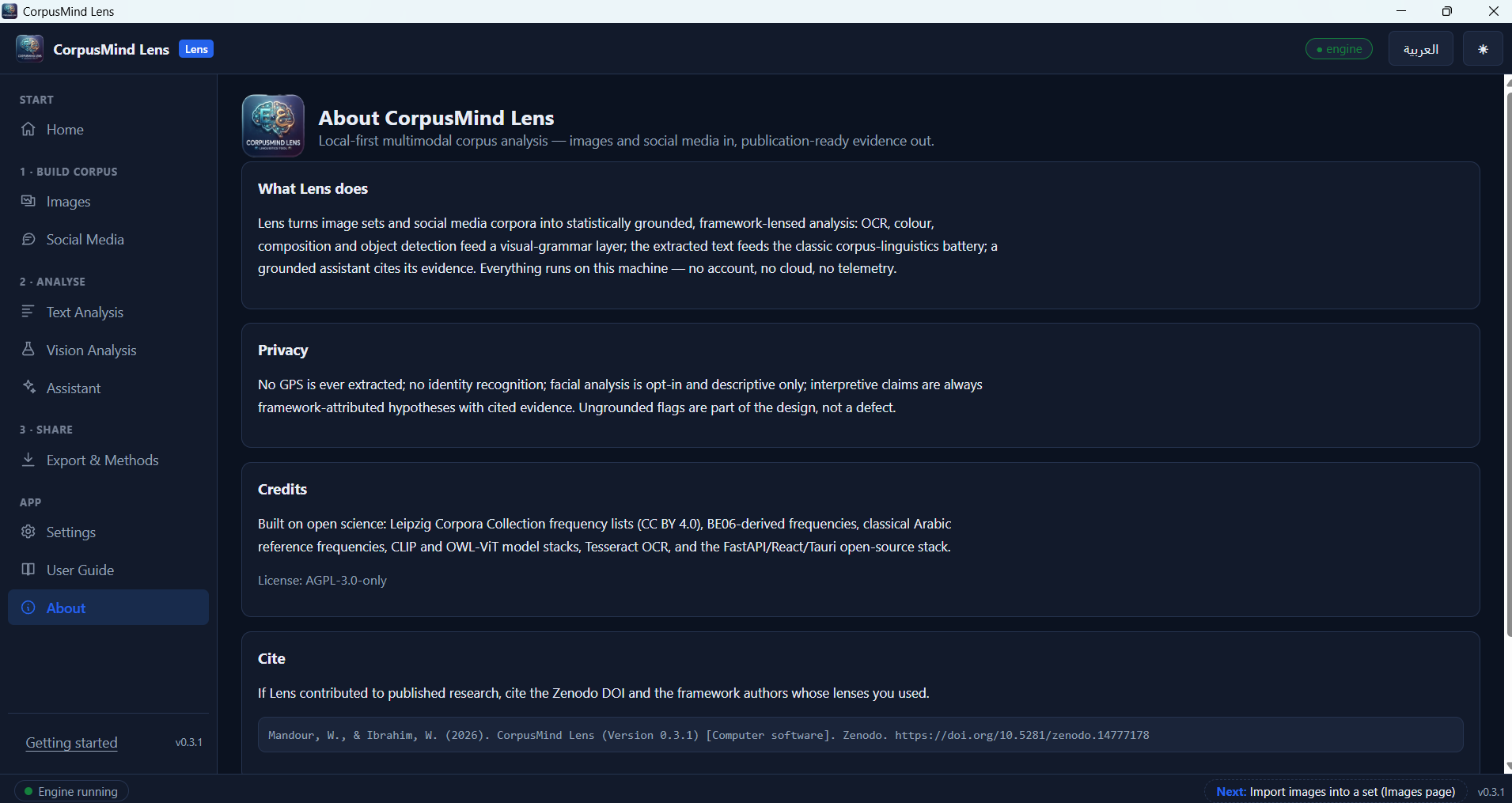
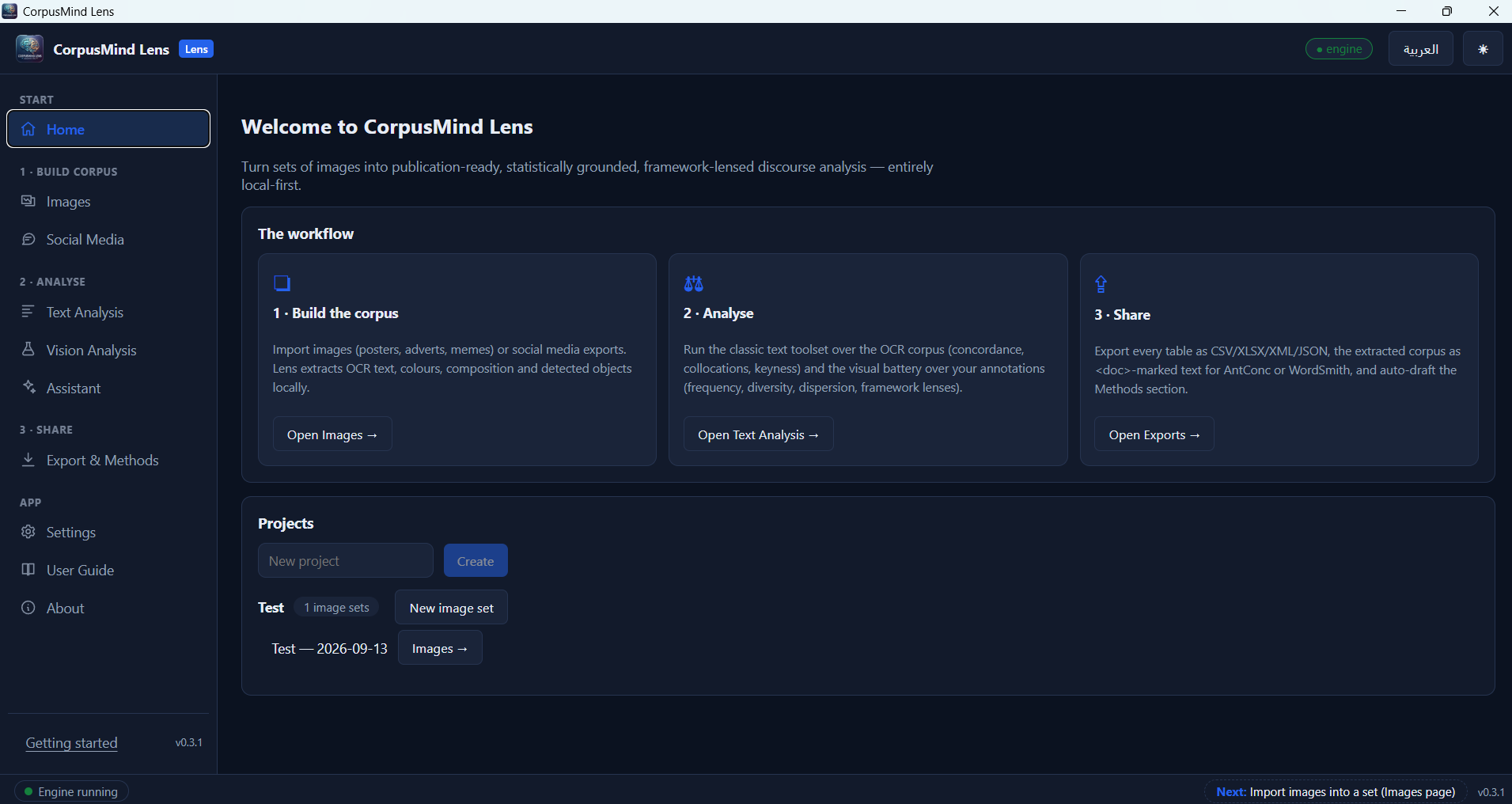
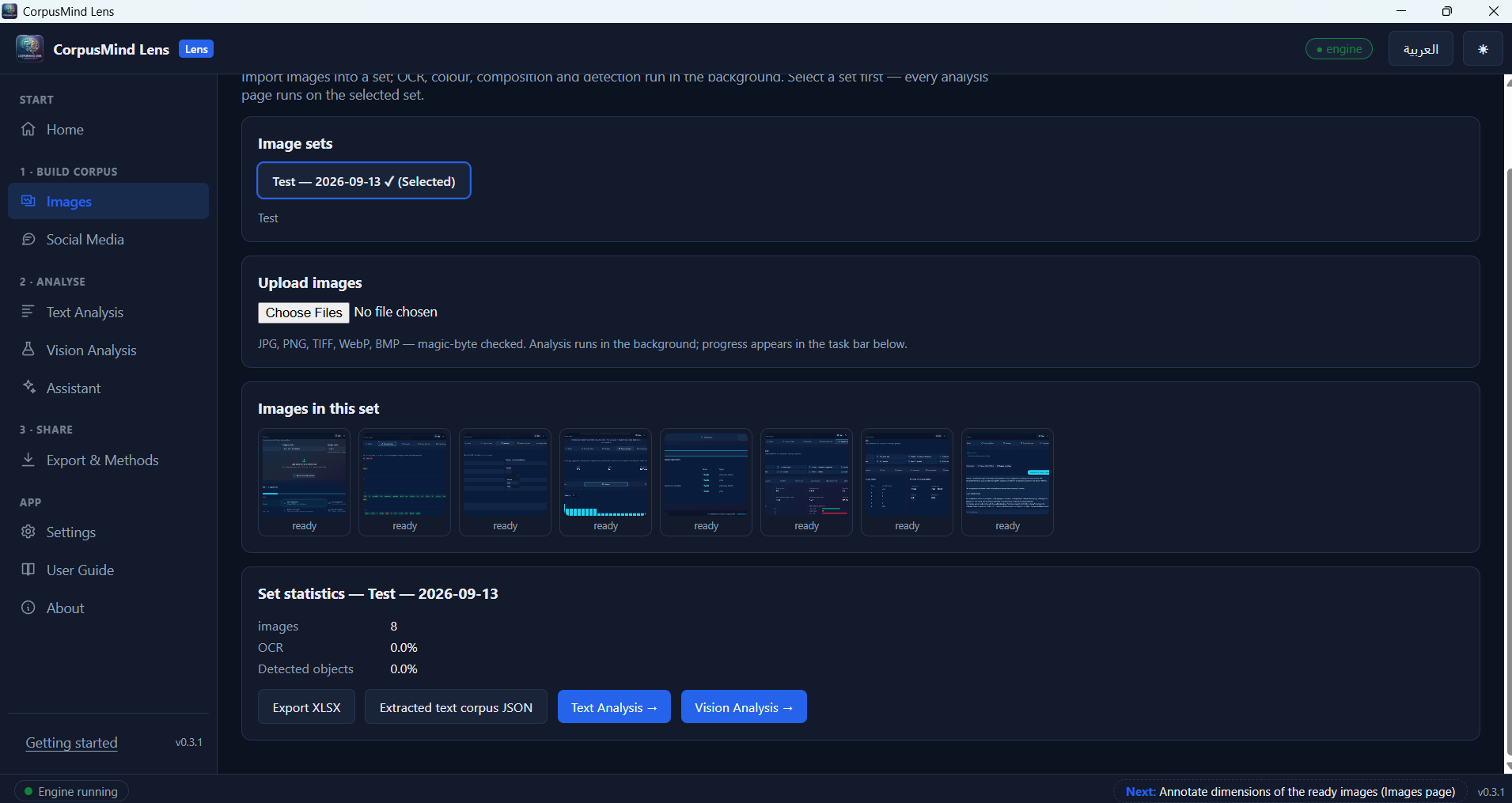
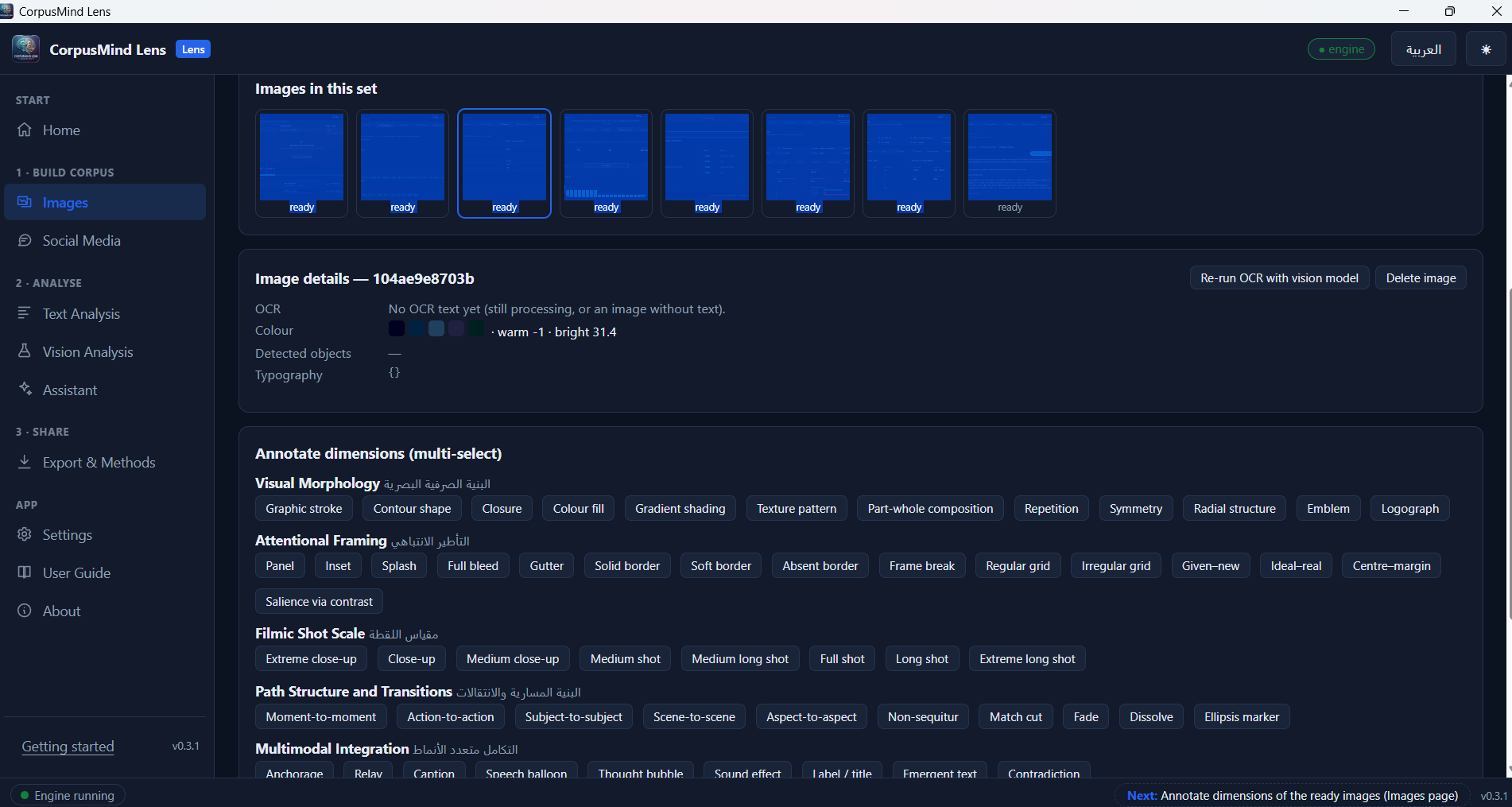
Swipe, use the ← → keys, or click a screenshot to open it full size اسحب أو استخدم مفتاحي السهمين، أو انقر على اللقطة لفتحها بالحجم الكامل
How CorpusMind Lens Compares
كيف يقارن كوربَس مايند لِنز
The following table compares CorpusMind Lens with established tools in qualitative data analysis, multimodal annotation, and cloud-based computer vision. Each tool has its strengths; CorpusMind Lens is the only one that combines vision-language models with explicit discourse-theoretical frameworks, local-first deployment, first-class Arabic support, and a reproducible analytical pipeline, all in a single free, open-source application.
يُقارن الجدول التالي كوربَس مايند لِنز مع الأدوات المعتمدة في تحليل البيانات النوعية، والوسم متعدد الأنماط، والرؤية الحاسوبية السحابية. لكل أداة نقاط قوتها؛ غير أنّ كوربَس مايند لِنز هو الأداة الوحيدة التي تجمع بين نماذج الرؤية اللغوية والأطر النظرية الصريحة لتحليل الخطاب، والتشغيل المحلي، والدعم المتقدم للغة العربية، ومسار تحليلي قابل لإعادة الإنتاج، في تطبيق واحد مجاني ومفتوح المصدر.
| Capability | القدرة | CorpusMind Lens | NVivo | ATLAS.ti | MAXQDA | ELAN | Google / Azure CV | Google / Azure CV | Multimodal Analysis (O'Halloran) | التحليل متعدد الأنماط (أوهالوران) |
|---|---|---|---|---|---|---|---|---|---|---|
| Multimodal discourse analysis (image + text) | تحليل الخطاب متعدد الأنماط (صورة + نص) | ✓ | ~ | ~ | ~ | ~ | ✗ | ✓ | ||
| Visual grammar (Kress & van Leeuwen) | القواعد البصرية (كريس وفان ليوين) | ✓ | ✗ | ✗ | ✗ | ✗ | ✗ | ~ | ||
| Critical discourse analysis (images) | التحليل النقدي للخطاب (الصور) | ✓ | ✗ | ✗ | ✗ | ✗ | ✗ | ✓ | ||
| Image–text alignment | محاذاة الصورة والنص | ✓ | ✗ | ✗ | ✗ | ✗ | ✗ | ~ | ||
| Vision-language model integration | تكامل نموذج الرؤية اللغوية | ✓ | ~ | ~ | ~ | ✗ | ✓ | ✗ | ||
| Reproducible / auditable pipeline | مسار تحليلي قابل لإعادة الإنتاج والتدقيق | ✓ | ~ | ~ | ~ | ~ | ✗ | ✗ | ||
| Local / offline capable | يعمل محليًا / دون اتصال | ✓ | ~ | ~ | ~ | ✓ | ✗ | ✓ | ||
| Arabic support (NLP + vision) | دعم اللغة العربية (معالجة + رؤية) | ✓ | ~ | ~ | ~ | ~ | ~ | ✗ | ||
| Free / open-source | مجاني / مفتوح المصدر | ✓ | ✗ | ✗ | ✗ | ✓ | ~ | ✗ | ||
| Privacy: data stays on device | الخصوصية: تبقى البيانات على الجهاز | ✓ | ✓ | ~ | ~ | ✓ | ✗ | ✓ | ||
| Ethical consent gate for person descriptions | بوابة موافقة أخلاقية للأوصاف الشخصية | ✓ | ✗ | ✗ | ✗ | ✗ | ✗ | ✗ |
✓ Full support · ~ Partial / limited · ✗ Not available. Cloud vision APIs (Google Cloud Vision, Azure Computer Vision) provide VLMs and Arabic OCR but lack discourse frameworks, visual grammar, image-text alignment, reproducible pipelines, and local deployment.
✓ دعم كامل · ~ جزئي / محدود · ✗ غير متاح. توفر واجهات الرؤية السحابية (Google Cloud Vision وAzure Computer Vision) نماذج رؤية لغوية واستخراج نصوص عربي، لكنها تفتقر إلى أطر تحليل الخطاب، والقواعد البصرية، ومحاذاة الصورة والنص، والمسارات القابلة لإعادة الإنتاج، والتشغيل المحلي.
Vision-Language Models
نماذج الرؤية اللغوية
CorpusMind Lens supports any vision-capable or text model available through Ollama or LM Studio. The built-in catalogue (Settings → AI backend & models) lists 13 curated models across vision, text, and embedding tasks, compares each entry with your machine's RAM and VRAM and shows an honest fit badge, and installs your pick with one click; Hugging Face GGUF search is built in. Highlighted entries:
يدعم كوربَس مايند لِنز أي نموذج رؤية أو نص متاح عبر Ollama أو LM Studio. يعرض الكتالوج المدمج (الإعدادات ← منصة الذكاء الاصطناعي والطُرز) 13 نموذجًا منسّقًا عبر مهام الرؤية والنص والتضمين، ويقارن كل نموذج بذاكرة جهزك ومعالج الرسوميات مع شارة ملاءمة صادقة، ويثبّت اختيارك بنقرة واحدة؛ مع بحث مدمج في مستودعات Hugging Face GGUF. أبرز النماذج:
qwen2.5vl:3b
3.2 GB · 3B parameters · 8 GB RAM
Best small local vision model with strong OCR and Arabic text reading. Recommended default for image description, annotation, and vision OCR.
3.2 جيجابايت · 3 مليارات مَعامل · 8 جيجابايت رام
أفضل نموذج رؤية محلي صغير مع قراءة نصوص وعربية قوية. الخيار الافتراضي الموصى به لوصف الصور والوسم واستخراج النصوص بالرؤية.
llama3.2-vision:11b
7.9 GB · 11B parameters · 16 GB RAM
Higher-fidelity image understanding for complex visual discourse analysis. English-centric; weaker Arabic OCR.
7.9 جيجابايت · 11 مليار مَعامل · 16 جيجابايت رام
فهم عالي الدقة للصور لتحليل الخطاب البصري المعقد. منحَز للإنجليزية؛ أضعف في القراءة العربية.
gemma3:4b
3.3 GB · 4B parameters · 8 GB RAM
Multilingual (including Arabic) for text and vision; a good balance of size and capability for the LLM framework modes and the Assistant.
3.3 جيجابايت · 4 مليارات مَعامل · 8 جيجابايت رام
متعدد اللغات (بما في ذلك العربية) للنص والرؤية؛ توازن جيد بين الحجم والقدرة لأوضاع الأطر بالنموذج اللغوي والمساعد.
bge-m3
1.2 GB · 568M parameters · 4 GB RAM
Multilingual embeddings (100+ languages, strong Arabic) powering semantic search over OCR text and captions. Recommended on every installation.
1.2 جيجابايت · 568 مليون مَعامل · 4 جيجابايت رام
تضمينات متعددة اللغات (أكثر من 100 لغة مع دعم عربي قوي) تشغّل البحث الدليلي عبر النصوص المستخرجة والتعليقات. موصى به في كل تثبيت.
Companion Application: CorpusMind
التطبيق المرافق: كوربَس مايند
CorpusMind Lens is the visual and social media companion to CorpusMind, the full corpus linguistics research environment for text corpora. CorpusMind provides concordance, frequency, collocation, keyness, dispersion, n-grams, POS analysis, grammar, dependency parsing, discourse analysis, vocabulary profiling, sentiment analysis, metaphor detection, Arabic NLP (CAMeL Tools), reference corpus management, and a grounded AI Assistant with 25 registered tools. Both applications are free and open source and can be installed side by side.
كوربَس مايند لِنز هو الرفيق البصري ووسائل التواصل لـكوربَس مايند، بيئة البحث الكاملة في لغويات المدونة للنصوص. يوفر كوربَس مايند الكونكوردانس، والتردد، والتجاور، والمفتاحية، والتشتت، والـn-grams، وتحليل أجزاء الكلام، والقواعد، وتحليل التبعية، وتحليل الخطاب، وتحليل المفردات، وتحليل المشاعر، واكتشاف الاستعارة، ومعالجة اللغة العربية (CAMeL Tools)، وإدارة المدونات المرجعية، ومساعد ذكي موثّق بـ25 أداة مسجلة. كلا التطبيقين مجاني ومفتوح المصدر ويمكن تثبيتهما جنبًا إلى جنب.
Visit CorpusMind زيارة كوربَس مايندDownload CorpusMind Lens
تحميل كوربَس مايند لِنز
Version 0.3.2, free and open-source (AGPL-3.0-only). No subscription, no telemetry, no cloud dependency.
Version 0.3.2 · AGPL-3.0-only · Third-party licenses
Live Statistics
الإحصاءات المباشرة
Downloads by Platformالتحميلات حسب المنصة
Data fetched from GitHub Releases API · updates in real timeالبيانات من واجهة GitHub Releases · تُحدّث في الوقت الفعلي